
Knowledge base
Drop forging and grain flow
Why a forged bolt head withstands more than a turned one
Term explained
Why a forged bolt head withstands more than a turned one
In closed-die forging, a bar billet heated to forging temperature is shaped in a two-part tool, the die, under the pressure of a forging press. The material flows into the die impression and takes on the shape of the head: hexagon, cylinder with hexagon socket, T-head, collar or special contour. In open-die forging, there is no die impression; the part is upset and drawn out between flat or simple tools, for example for collars on large bolts or for blanks that are subsequently turned.
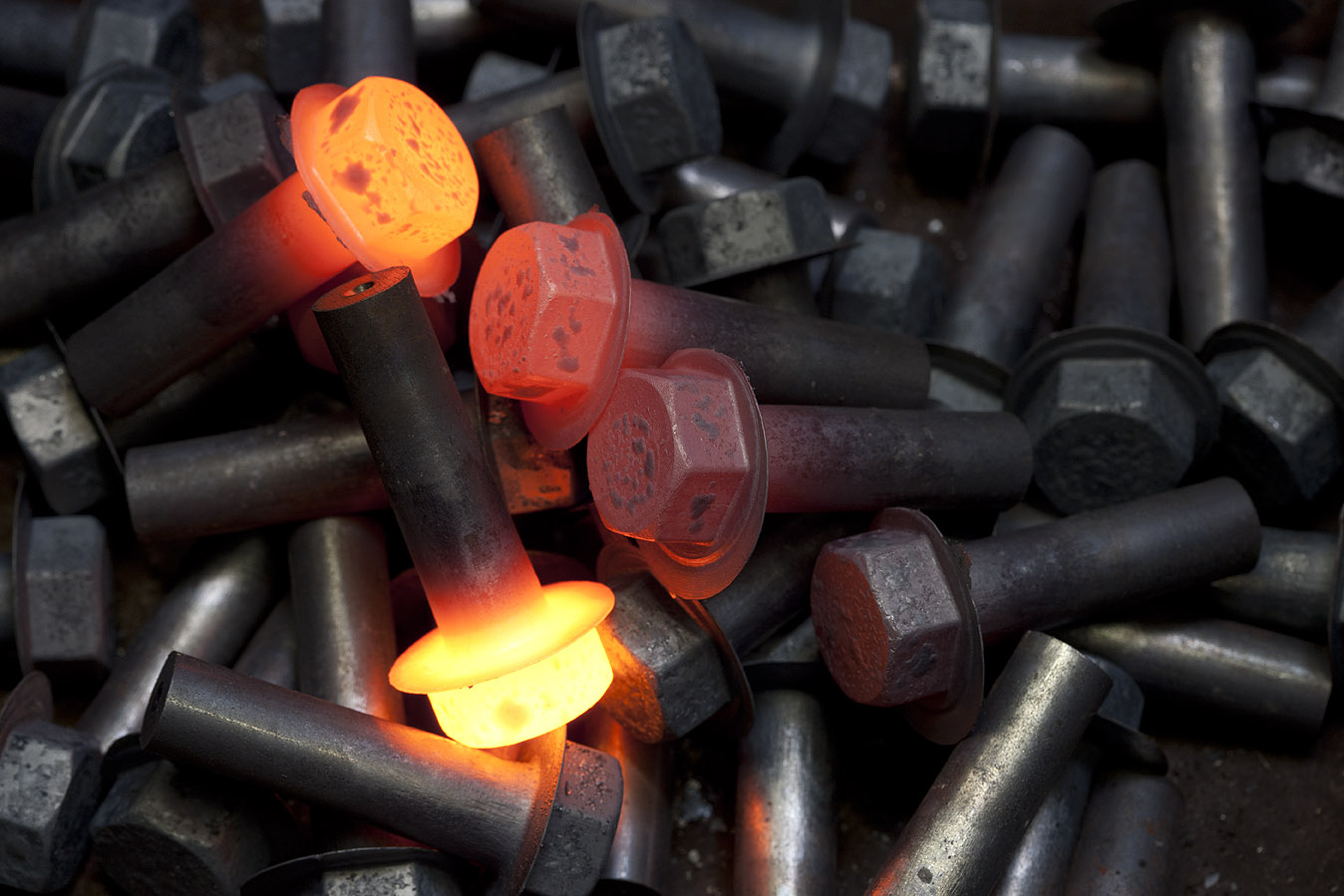
Grain flow
Rolled steel has a fibrous structure in the rolling direction: inclusions and segregations lie as fine lines along the bar. If a head is machined from solid, turning cuts across these fibres at the transition from head to shank. In forging, by contrast, the fibres follow the shape of the head, run around the edge and remain uninterrupted. Precisely at the transition, where the bolt is most highly stressed in tension and bending, a forged head therefore withstands a considerably higher number of load cycles. For dynamically loaded joints and for property classes 10.9 and 12.9, this is the reason to have heads forged, even if turning would be simpler for small quantities.
How RS Randack forges
On forging presses for closed-die and open-die forging, with induction heating of the billets and temperature monitoring, using dies from our own toolroom. Before the lot is run, a forging trial piece is produced and measured; only then does the lot go ahead, and the first blank and ongoing random samples are inspected. Hot forming is typically up to M64, larger sizes on request. After forging, depending on the material, the parts are cooled under controlled conditions or annealed, followed by quenching and tempering, turning and thread rolling. The billets for nuts are also pierced and forged.
What you should specify
Head shape with dimensions or standard, property class or material, quantity, whether a die to drawing is required, and whether the grain flow is to be verified in the certificate or by a metallographic section.
Enquire about forged special fasteners
Urgent? You will hear from us within a few hours.