Production
Forging and hot forming
Heads, collars and nuts with continuous grain flow
Step 2
Heads, collars and nuts with continuous grain flow
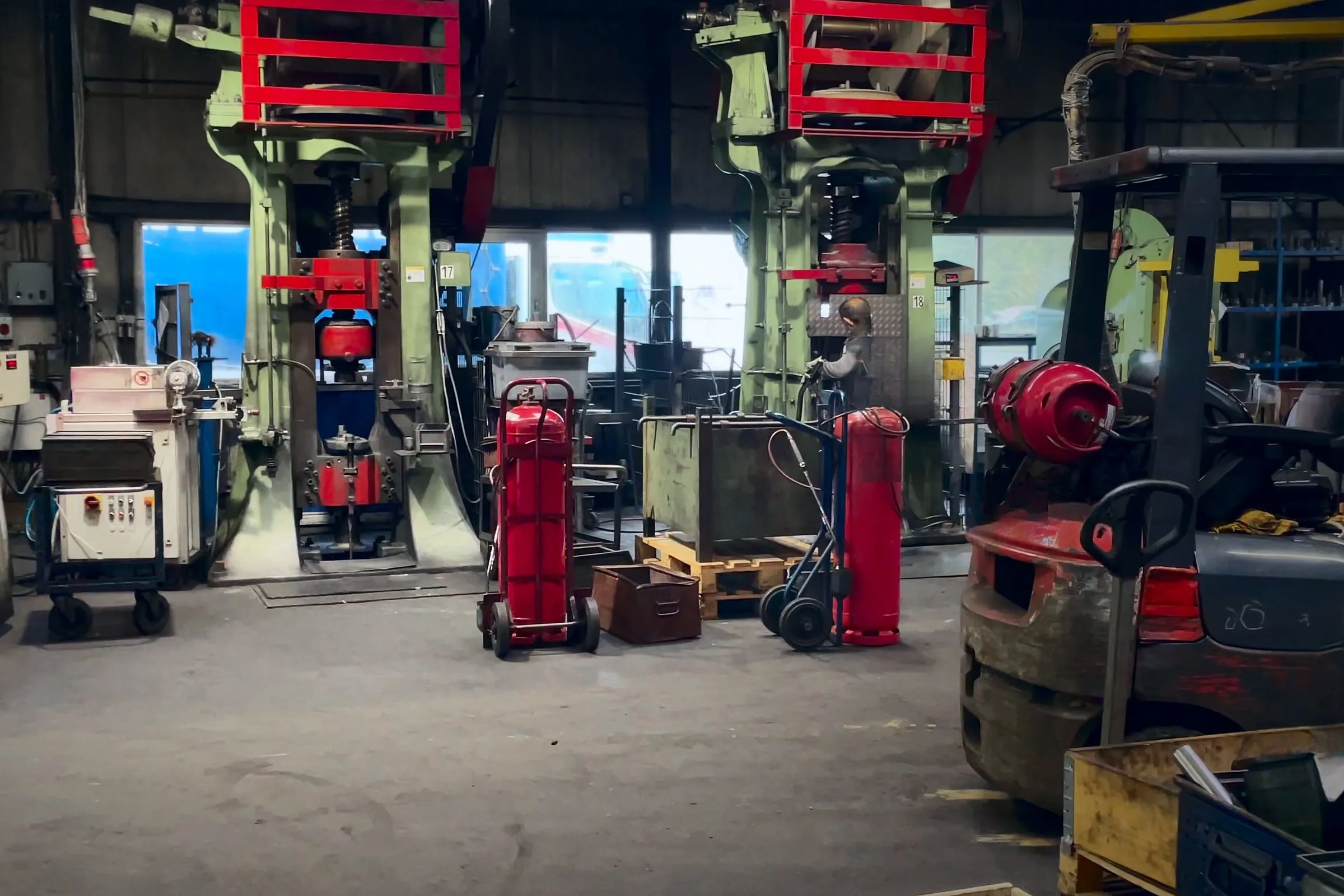
In its own forge, RS Randack hot-forms bolt heads, collars, squares and nut blanks from the sawn billet. The billet is induction-heated and shaped on forging presses in a die made in our own toolroom; nuts are hot-pierced instead of drilled. At RS Randack, hot forming is typically possible up to M64, larger sizes on request. RS Randack has been assessed by TÜV NORD as a material manufacturer to AD 2000 Merkblatt W0.
M64
Hot forming, typically up to
1,200 °C
Forging temperature, Q&T steels
70 mm
Billets induction-heated, typically up to
RS
Manufacturer’s mark in the die
Why forged rather than machined from solid?
In forging, the grain flow of the steel follows the contour of the part: the grain runs uninterrupted from the shank into the head. If, on the other hand, the head is turned from a thick bar, the grain flow is cut through at the transition. The forged head-to-shank transition therefore withstands significantly more under alternating load, and it is precisely there, at the transition from head to shank, that machined bolts fail first. There is also the material consumption: for an M48 hex head bolt machined from solid, the entire length would have to be turned from bar stock at the full width across flats. Closed-die forging in small and medium lots is RS Randack’s niche: high-volume runs are produced on cold headers, while RS Randack hot-forms parts to drawing itself, from single pieces up to several thousand.
How does the forging process work?
- Tooling: The works order goes to the toolroom first. If no die exists, it is made in-house; existing tools are checked for function before every lot.
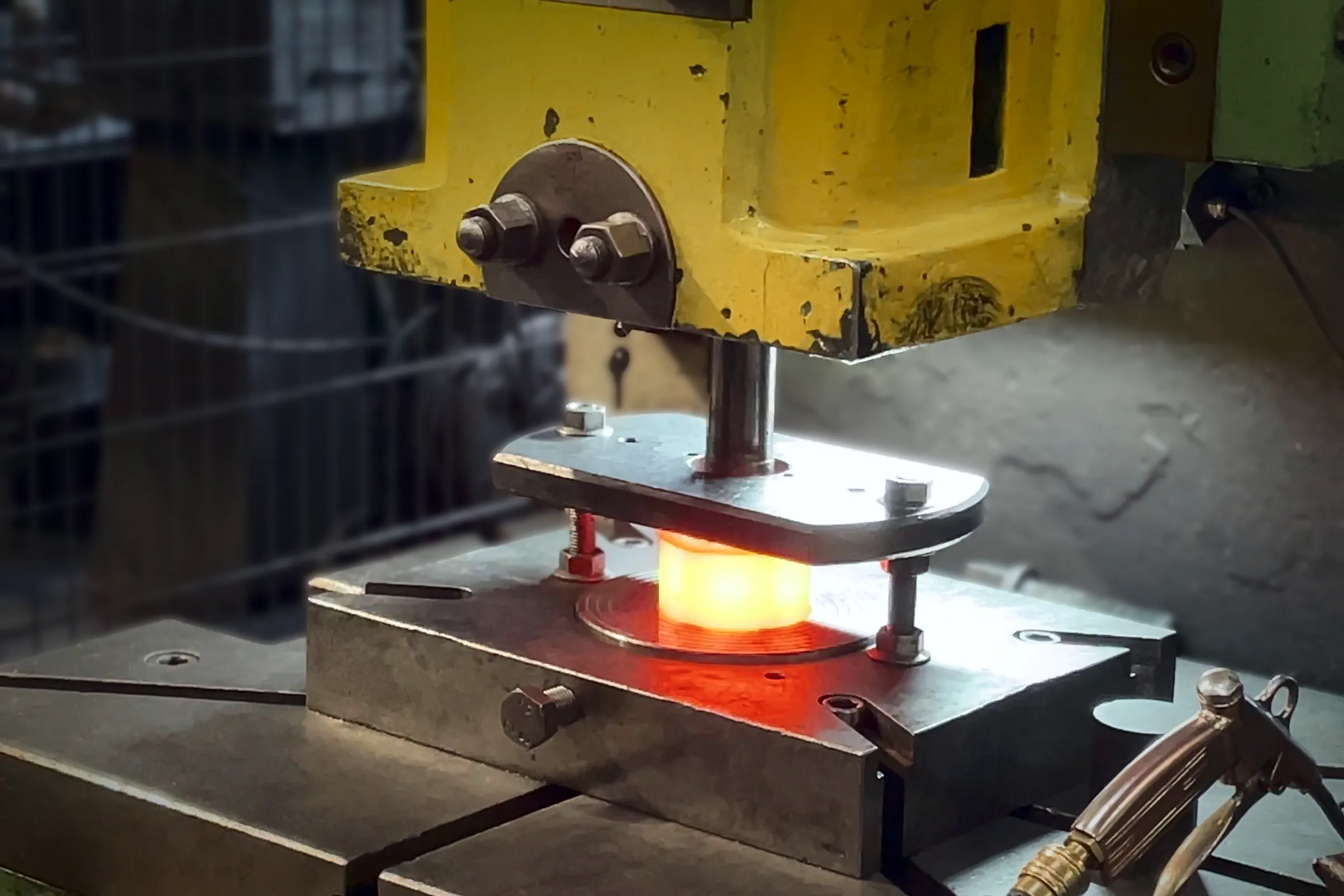
- Heating: Induction heating with four coils for billets up to 70 mm in diameter and 120 mm heated length, larger billets in the furnace. Time and power are stored for each part so that the core of the billet also reaches forging temperature.
- Temperature: Q&T steels are forged at 1,000 to 1,200 °C, stainless and heat-resistant steels according to our own table. Pyrometers on the press monitor the temperature with an audible alarm. Reheating is not permitted; overheated billets are scrapped.
- Forming: Pre-upsetting, then the finishing blow in the preheated die. In the same stroke, the tool stamps the marking: manufacturer’s mark RS and order number.
- Release: The first part of the lot is fully measured and signed off on the works order, then at least every fiftieth part and the last one.
- Cooling: Depending on the material, in air, slowly in charcoal or in water, according to a table. High-alloy Q&T steels such as 30CrNiMo8 and high-temperature steels cool slowly to prevent cracking.
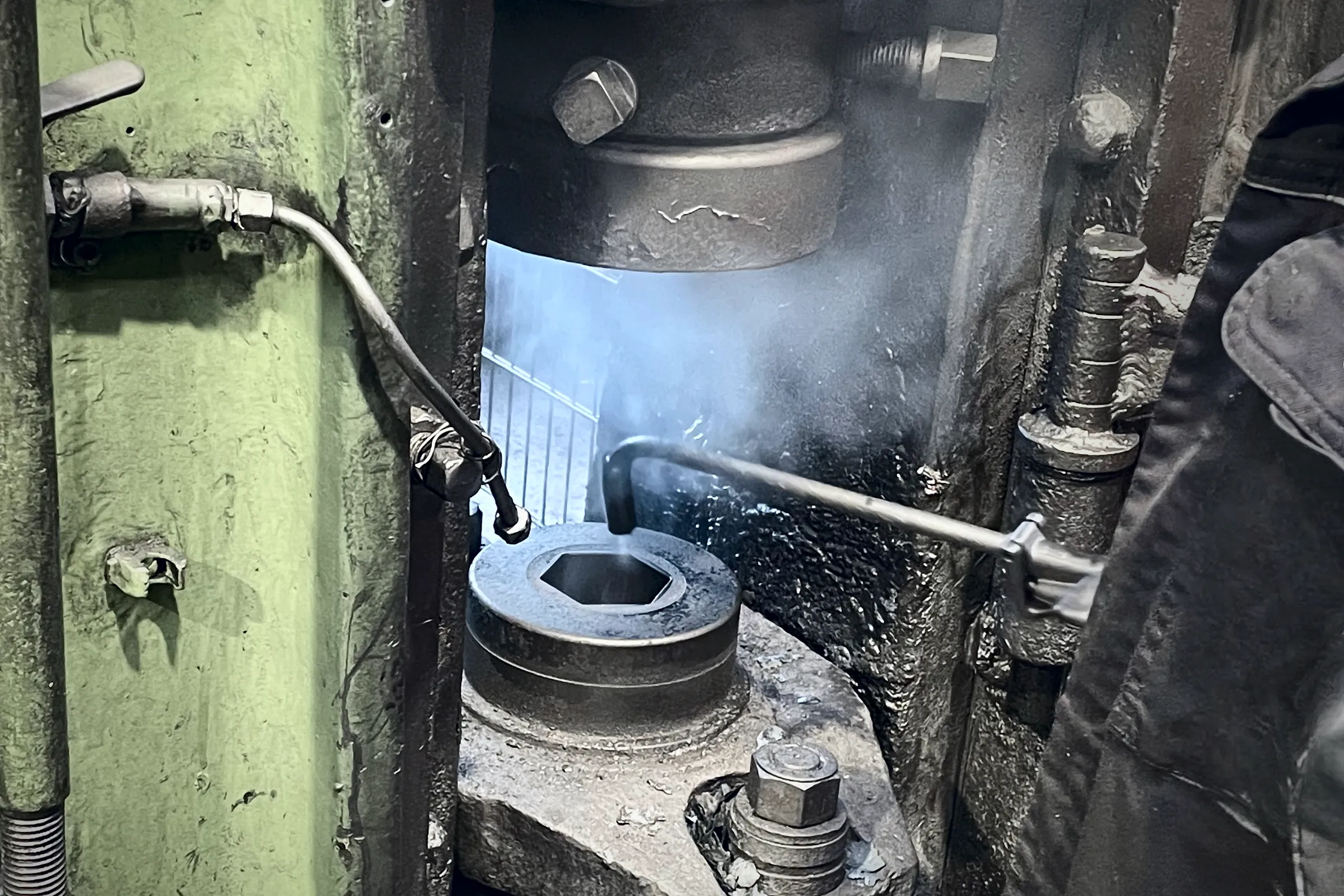
Forging trials and stock allowance
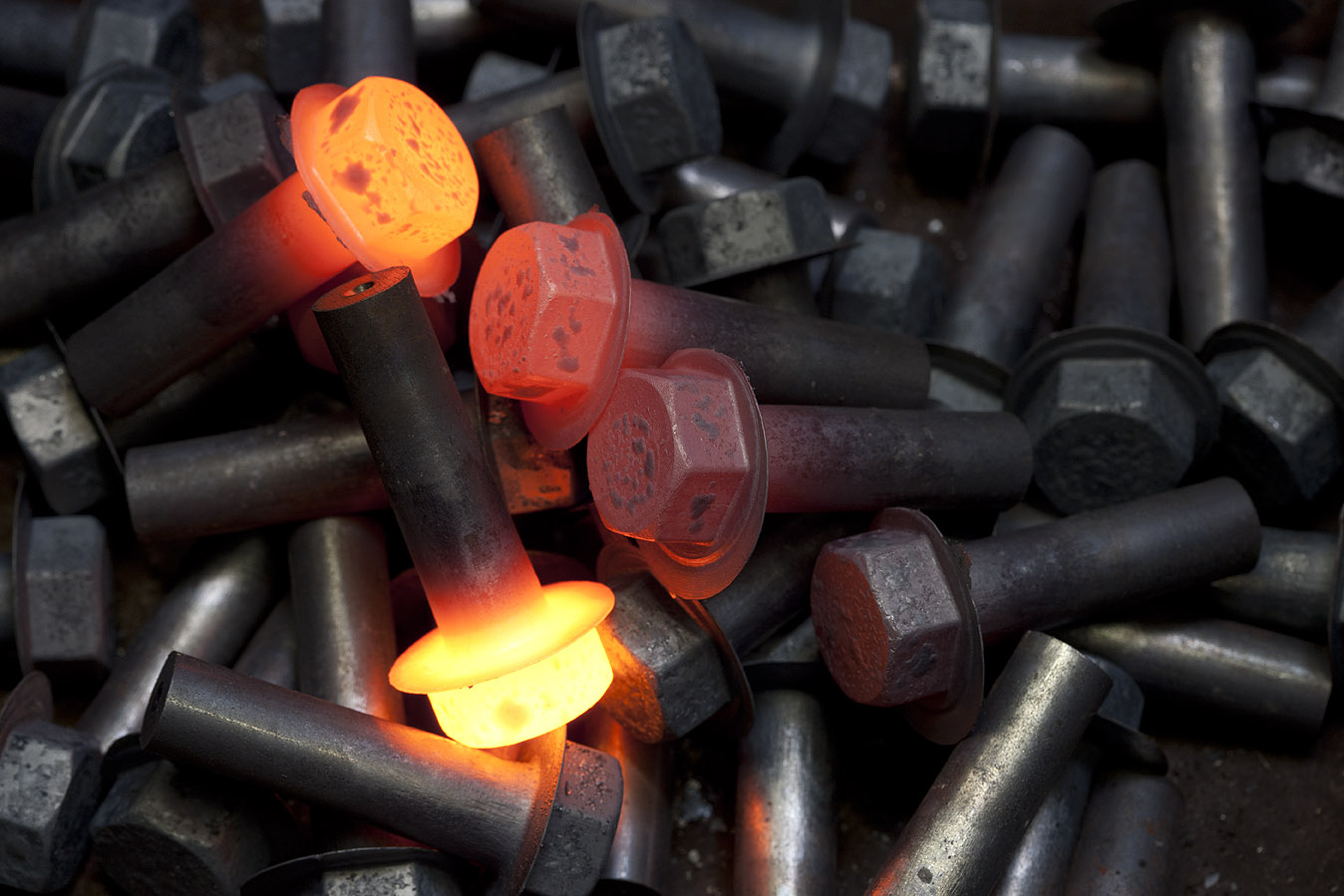
For a new item, the forge uses a few billets of different lengths to determine the shortest billet length that completely fills the head. The result, the allowance, is documented for repeat orders; the saw only cuts the lot after this release. This avoids scrap in expensive material, and repeat orders run without a trial.
Nuts from the forge
Special nuts are not drilled from hexagon bar but hot-preformed from round bar and hot-pierced on the piercing press. This saves material and preserves the grain flow in the nut body. After forging, nuts cool slowly so that they machine evenly; finish machining and the internal thread are carried out in nut machining.
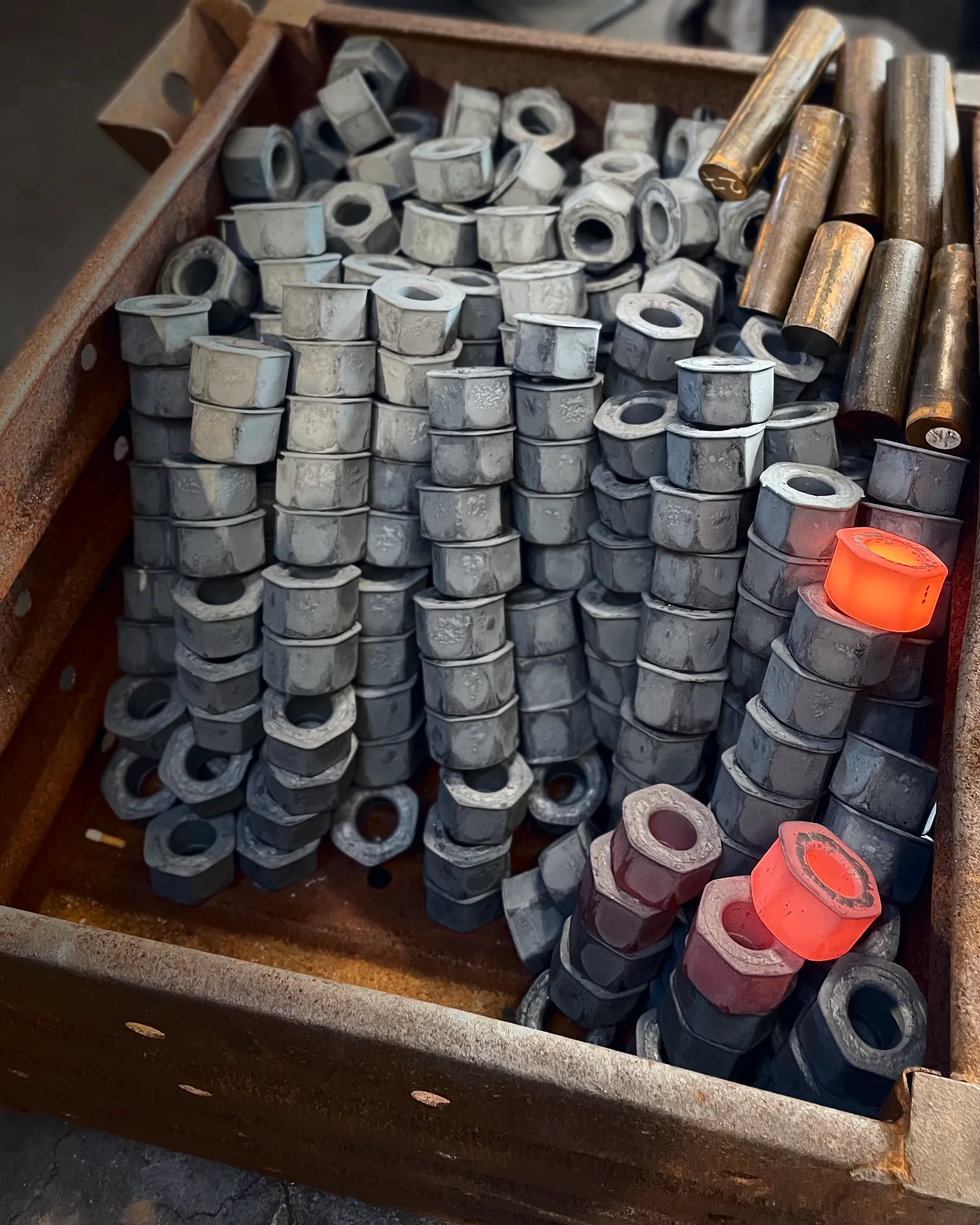
What follows forging
The forged blanks are shot-blasted and go to a partner for heat treatment, return to our plant, are checked for hardness on one part and are then finish-machined on the CNC turning centres. The certificate for the batch accompanies every lot, see Inspection certificates 3.1 and 3.2.
Frequently asked questions
Questions and answers about forging
Which parts does RS Randack forge?
Hex, square and cylindrical heads, T-heads, collars and shoulders on screws and bolts, as well as nut blanks, hot-formed typically up to M64, in lots from a few pieces to several thousand.
Why are forged bolts stronger?
Because the grain flow runs uninterrupted from the shank into the head. As a result, the head-to-shank transition, the critical point under alternating load, has a higher fatigue strength than heads machined from solid.
Does RS Randack also forge stainless steels?
Yes, austenitic and heat-resistant steels are forged according to our own temperature table and cooled according to the material.
Enquire about forged special fasteners and nuts to drawing
Urgent? You will hear from us within a few hours.