
Knowledge base
Fatigue strength and notch effect in bolts
Why bolts under cyclic loading fracture in the thread, and what helps prevent it
Term explained
Why bolts under cyclic loading fracture in the thread, and what helps prevent it
A bolt that is loaded and unloaded a million times will fracture at a force far below its tensile strength. This is fatigue: a microscopic crack forms at a stress peak and grows a little with every load cycle until the remaining cross-section fractures. The fracture surface shows this clearly: a smooth, often striated zone of slow crack growth and a rough final fracture zone. Fatigue strength is the stress amplitude that a bolt can withstand an unlimited number of times; for bolts, it is only about 5 to 10% of the tensile strength, because the thread is a sharp notch.
Where bolts fracture
Almost always at the first engaged thread under the nut, where the load is highest and the notch of the thread root takes effect; less often at the transition from head to shank or at the thread run-out. Notch effect means that at a sharp contour, the stress is concentrated to several times the level in the plain shank. The smaller the radius, the higher the peak.
What increases fatigue strength
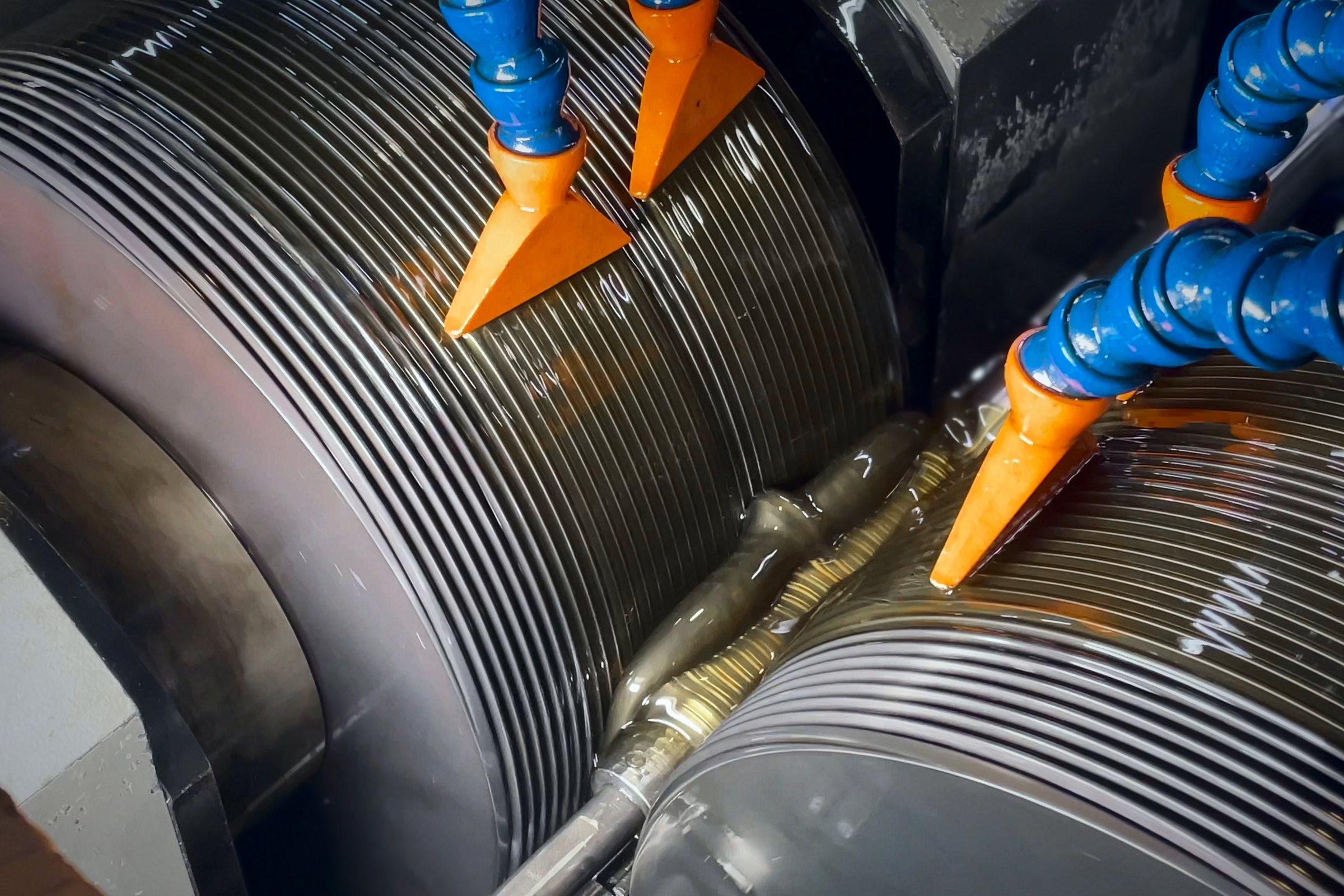
- Rolled rather than cut threads: Compacted flanks, uninterrupted grain flow, smooth thread root.
- Final rolling after quenching and tempering: Compressive residual stresses in the thread root counteract the tensile stresses and increase fatigue strength considerably further.
- Large root radius: UNR, UNJ and MJ profiles, undercuts with a radius, generously radiused transitions to the reduced shank.
- Forged head: The grain flow follows the contour, with no cut fibres at the transition.
- High preload and an elastic bolt: The higher the preload and the more elastic the bolt, the smaller the stress amplitude that reaches the bolt; reduced-shank bolts to DIN 2510 are designed on this principle.
- Flawless surface: No laps, cracks or surface decarburisation to ISO 6157, crack testing for critical parts.
What RS Randack contributes
Threads are rolled as standard, and rolled after heat treatment on request; heads are forged; transitions are turned with radii to drawing and ground where required; surfaces are inspected to ISO 6157; the material and its quenched and tempered condition are verified in our own laboratory. Fatigue tests on the component are carried out by accredited partner laboratories when the specification requires them.
What you should specify
Type of load and number of load cycles, required fatigue strength or testing, whether final rolling is required, radii and transitions on the drawing, scope of inspection to ISO 6157 and crack testing.
Enquire about fatigue-resistant bolts for cyclic loading
Urgent? You will hear from us within a few hours.