
Knowledge base
Tensile test
Tensile strength, yield strength and elongation on test bars and full-size bolts
Term explained
Tensile strength, yield strength and elongation on test bars and full-size bolts
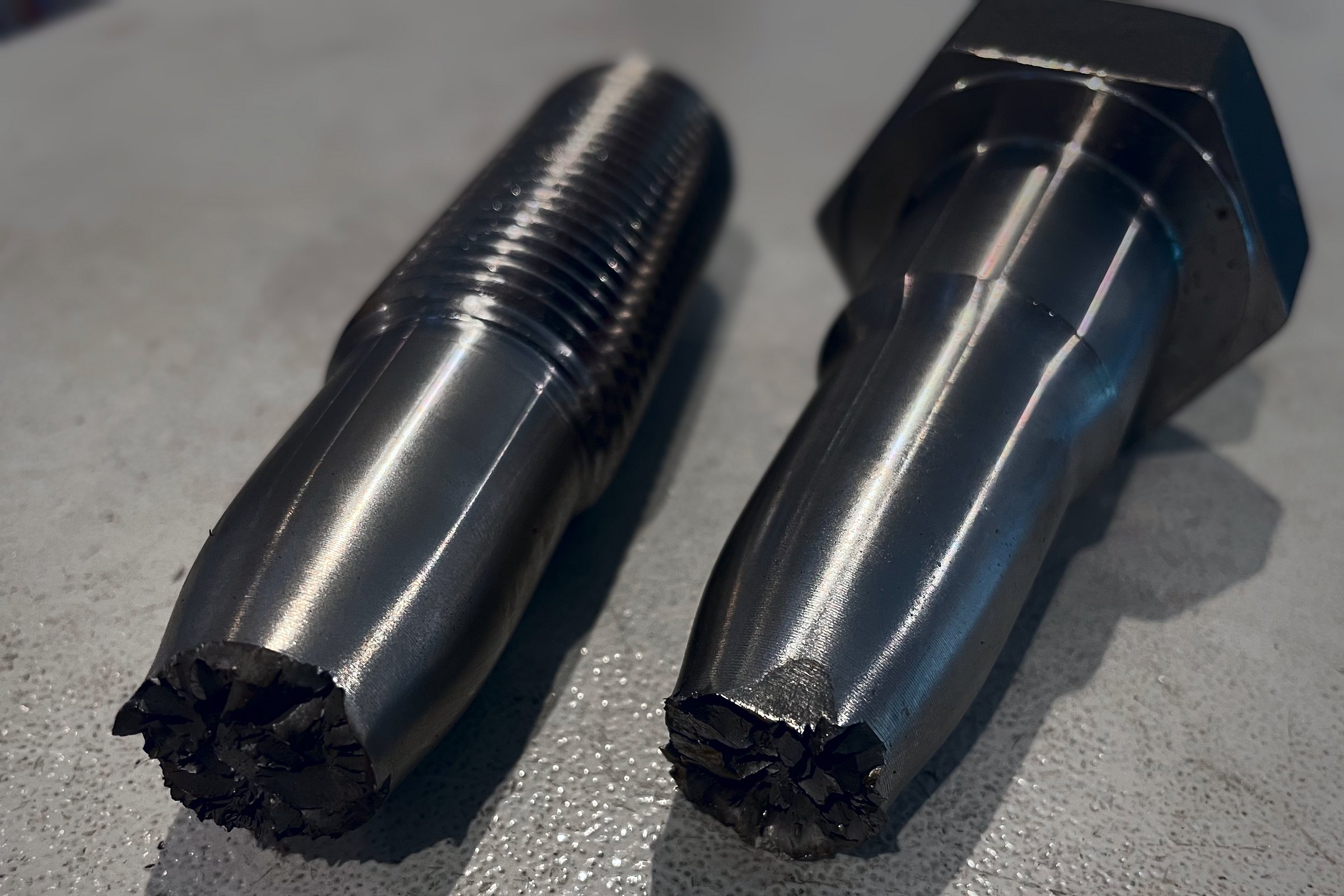
The tensile test is the most important destructive test for fastener materials. A specimen is pulled in the tensile testing machine with increasing force until it fractures; the force and extension give the tensile strength, yield strength or proof strength, elongation after fracture and reduction of area. Testing is carried out on test bars to ISO 6892-1 or to ASTM A370 and ASTM E8, or on the full-size bolt to ISO 898-1; specimen shape and test procedure depend on the standard or customer specification. In Hagen, RS Randack operates a 3,000 kN tensile testing machine on which full-size bolts up to M64 in 10.9 are tested, and a second machine for test bars, both calibrated regularly.
What the values mean
- Tensile strength: The maximum stress the material can withstand; at least 1,000 MPa for property class 10.9.
- Yield strength or 0.2% proof strength: The stress above which the material deforms permanently; it limits the permissible preload.
- Elongation after fracture and reduction of area: The amount of deformation before fracture, in other words the ductility. A brittle specimen fractures with a much smaller reduction of area.
Test bar or full-size bolt?
The turned test bar tests the material. The full-size bolt tests the component: the thread root, head-to-shank transition and notch effect all feed into the result, and the fracture occurs where it would also occur in service. Many specifications therefore require both. For railway applications, RS Randack carries out full-size tensile tests on a fixed sample from each lot on request, for example every 50th bolt, and attaches the test report to the certificate. For bolts that are designed to break at a defined force, the diameter is determined on the basis of tensile tests.
Elevated-temperature tensile test
For joints operating at high temperatures, the elevated-temperature yield strength is verified, for example at 300 °C. The elevated-temperature tensile test is carried out by an accredited partner laboratory; the values appear on the RS Randack certificate.
Enquire about tensile-tested bolts with a certificate
Urgent? You will hear from us within a few hours.