
Knowledge base
Property class 10.9
What 10.9 means, how it is achieved and how it is verified
Term explained
What 10.9 means, how it is achieved and how it is verified
Property class 10.9 to ISO 898-1 describes the mechanical properties of a bolt made of carbon or alloy steel: the first number multiplied by 100 gives the nominal tensile strength, here 1,000 MPa; the product of both numbers multiplied by 10 gives the nominal yield strength, here 900 MPa. The table in ISO 898-1 requires more than the nominal values: for 10.9, a minimum tensile strength of 1,040 MPa and a minimum yield strength of 940 MPa. A 10.9 bolt therefore withstands a tensile stress of at least 1,040 N/mm² and only begins to deform permanently at 940 N/mm². 10.9 is the property class most frequently requested at RS Randack, ahead of 8.8 and 12.9.
How is the property class achieved?
Not during turning or threading, but during quenching and tempering. Quenching and tempering is hardening followed by tempering: the part is heated above the transformation temperature, quenched and then tempered at a lower temperature. The tempering temperature sets the balance between strength and toughness. At RS Randack, heat treatment is carried out in close, long-standing cooperation with qualified partners; the hardness range for each material is specified on the works order, and verification takes place in our own laboratory.
Which materials achieve property class 10.9?
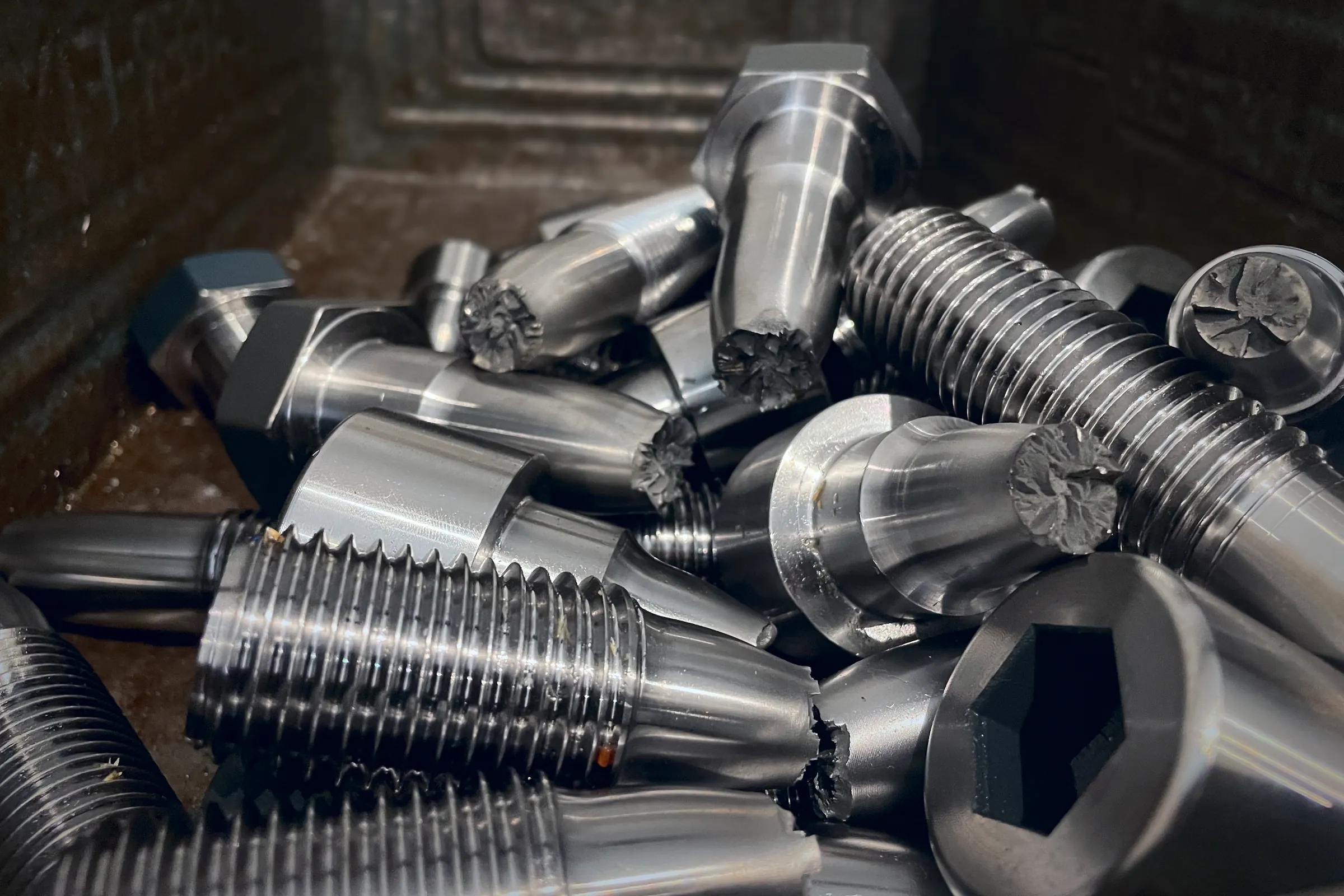
10.9 requires a quenched and tempered steel that hardens through at the required diameter. For small and medium sizes, 42CrMo4 (1.7225) is the most widely used material; for large diameters and for 12.9, higher-alloy steels such as 30CrNiMo8 (1.6580) or 34CrNiMo6 are used because they achieve a tempered martensitic structure even in the core of the cross-section. For joints at high temperatures, creep-resistant steels such as 21CrMoV5-7 (1.7709) or 40CrMoV4-6 (1.7711) to EN 10269 are used; for low temperatures, materials with verified impact energy at the test temperature.
Which nut goes with a 10.9 bolt?
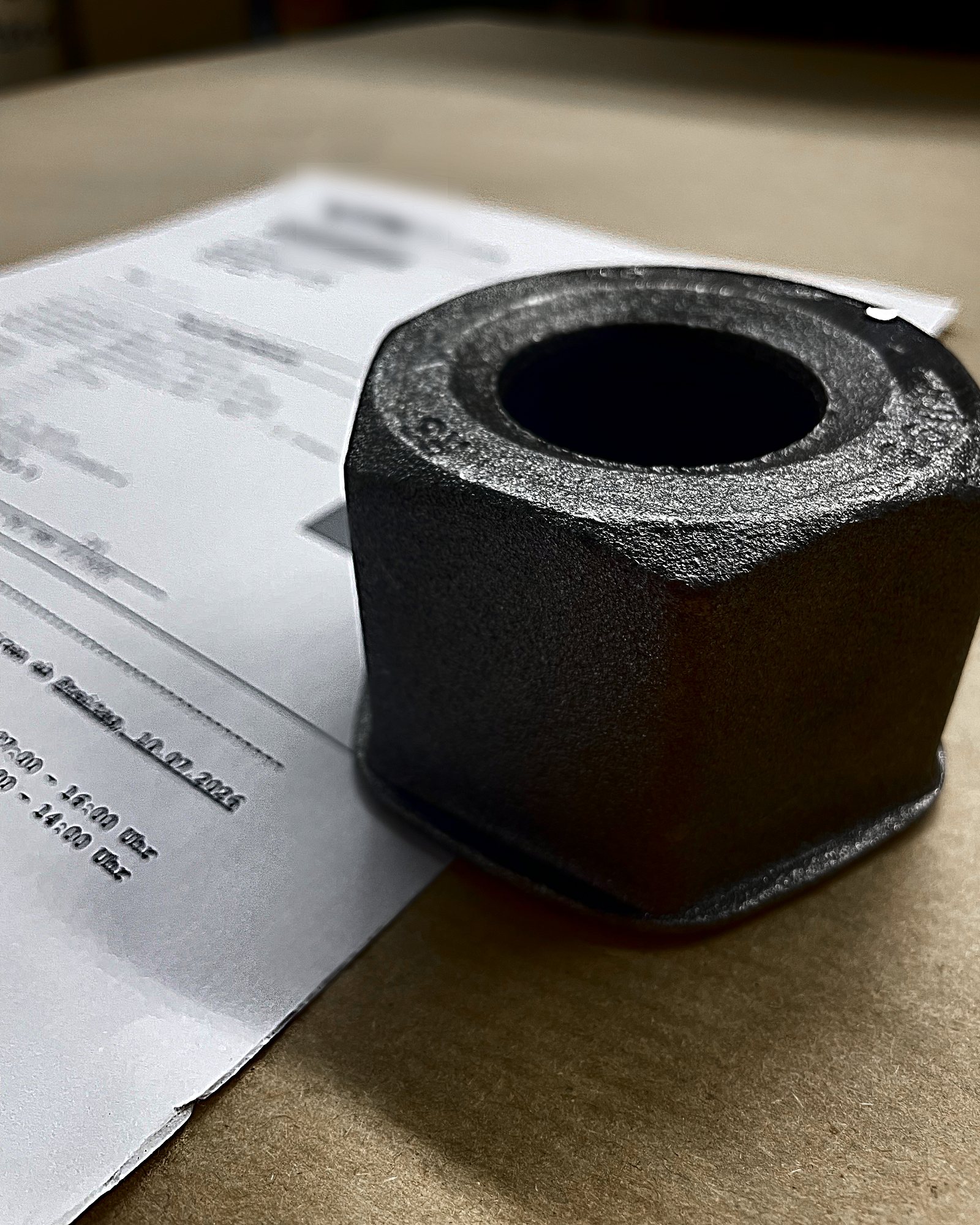
Under ISO 898-2, a property class 10 nut. The number corresponds to the first number of the bolt: class 8 for 8.8, class 10 for 10.9, class 12 for 12.9. The nut is designed so that, in the event of overload, the bolt fractures in the free threaded length rather than the nut thread stripping. RS Randack produces special nuts to match the bolt from the same production, see Nut machining.
How is 10.9 verified?
- Hardness testing per batch to Brinell, Vickers or Rockwell. For 10.9, the hardness is in the range of approximately 320 to 380 HV; the value is recorded on the job card.
- Tensile test on the test bar, which comes from the same heat and passes through all production steps with the lot: tensile strength, yield strength, elongation, reduction of area.
- Full-size bolt tensile test on the tensile testing machine up to 3,000 kN. A full-size bolt test is more representative than a turned test bar because the thread and the head-to-shank transition are tested as well.
- Microstructural examination in the micrograph and, where required, a hardness profile across the section.
The values are documented in the 3.1 or 3.2 inspection certificate. If a sample fails, the entire lot is blocked until the deviation has been resolved.
Does ISO 898-1 also apply to large bolts?
ISO 898-1 applies to threads up to M39. For larger sizes, which are everyday work at RS Randack, the mechanical properties are agreed on the basis of the standard or to your specification and verified by tensile tests on the test bar and on the full-size bolt. For large sizes, please therefore state the required minimum values and the test standard in addition to the property class.
What to watch out for with 10.9
- Hydrogen embrittlement: From 10.9 upwards, susceptibility to hydrogen from electroplating processes increases. For high-strength parts, we recommend zinc flake systems instead of zinc electroplating; see Hydrogen embrittlement for more.
- Threads: Rolled for dynamic loads; for high stresses, rolled after heat treatment, see Rolling after heat treatment.
- Notch sensitivity: Toughness decreases as strength increases. Radiused transitions, rolled threads and, where required, crack testing safeguard the joint.
Frequently asked questions
Questions and answers about property class 10.9
What does 10.9 mean for bolts?
10.9 is a property class to ISO 898-1: nominal tensile strength 1,000 MPa and nominal yield strength 900 MPa; the minimum values in the standard are 1,040 and 940 MPa. The class is achieved by quenching and tempering, i.e. hardening followed by tempering.
What is the difference between 8.8, 10.9 and 12.9?
The nominal tensile strength rises from 800 to 1,000 and 1,200 MPa, the nominal yield strength from 640 to 900 and 1,080 MPa; the minimum values in the standard are slightly higher in each case, for 10.9 at 1,040 and 940 MPa. Hardness and notch sensitivity increase with strength; 12.9 requires the most careful heat treatment and thread inspection.
Does RS Randack also produce special strengths?
Yes. ISO 898-1 ends at 12.9; RS Randack produces special strengths to customer specification, with material selection, matched heat treatment and verification in our own laboratory. Send us your enquiry with drawing, material and required mechanical properties.
Enquire about bolts in 10.9 and higher to drawing
Urgent? You will hear from us within a few hours.