Knowledge base
Property classes of nuts to ISO 898-2
Which nut goes with which bolt, and what the proof load test demonstrates
Term explained
Which nut goes with which bolt, and what the proof load test demonstrates
Like bolts, nuts have property classes, standardised in ISO 898-2: 04, 05, 5, 6, 8, 10 and 12. The number corresponds to one hundredth of the proof load stress, in newtons per square millimetre, that a bolt may reach in a tensile test through the nut without the thread stripping. A class 10 nut therefore carries a bolt with up to 1,000 N/mm² tensile strength, which is 10.9. The rule: the nut class is at least the first number of the bolt class, class 8 with 8.8, class 10 with 10.9, class 12 with 12.9. A higher nut class does no harm; a lower one causes the joint to fail in the thread before the bolt breaks.
Nut height and thread stripping
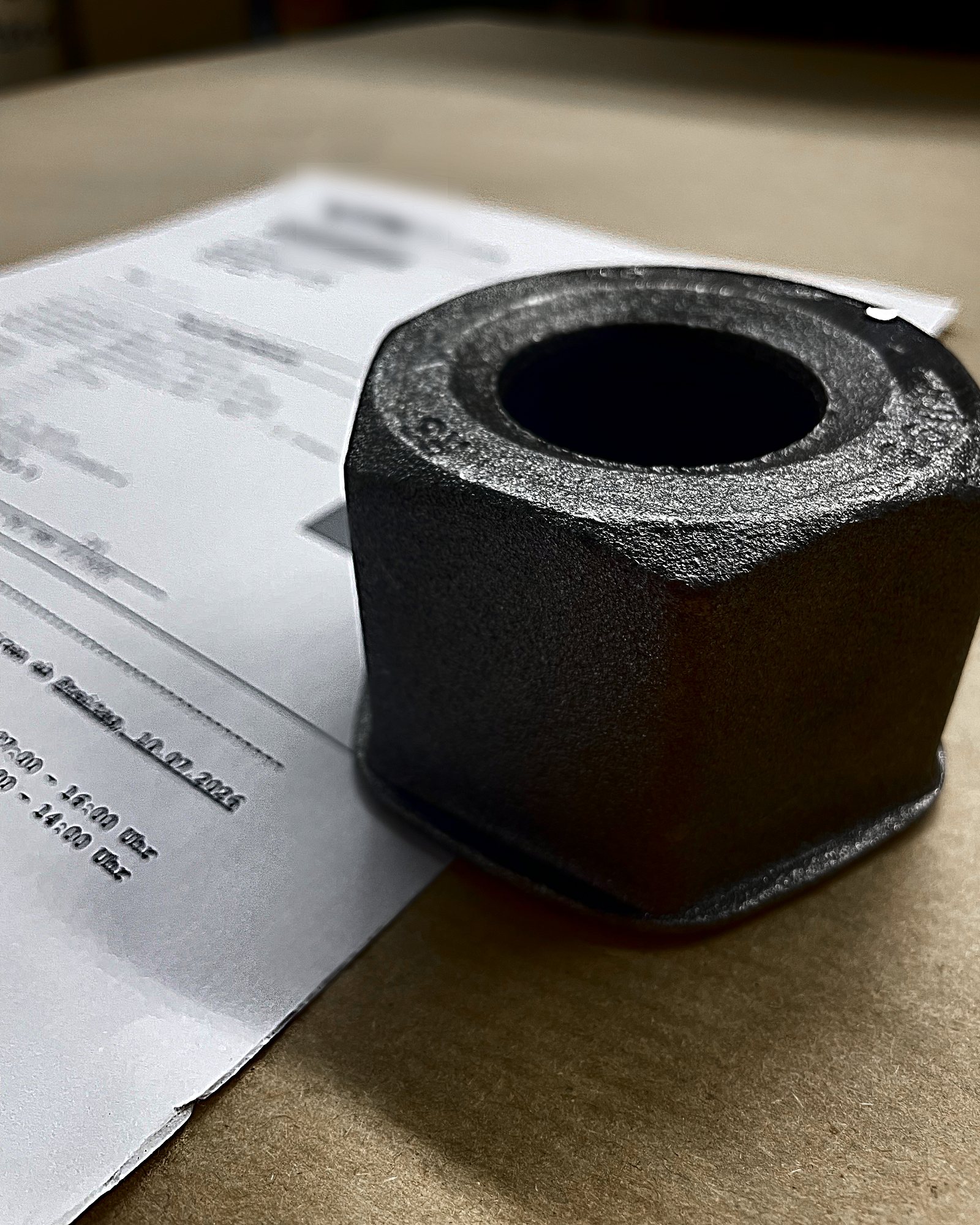
Whether the nut carries the full bolt load depends not only on its strength but also on its height: regular nuts to ISO 4032, at around 0.8 d, are designed for full load capacity, while thin nuts to ISO 4035, at 0.5 d, only reach classes 04 and 05 and serve as jam nuts. High nuts to ISO 4033, nuts for reduced-shank bolts to DIN 2510 and heavy hex nuts to ASME provide reserve capacity for high-strength joints and joints at elevated temperatures. With soft mating materials, for example studs in grey cast iron, the metal end is decisive, not the nut.
American and special nuts
Instead of numbers, ASTM A194 uses grades such as 2H, 4, 7 and 8, which match B7, B16, L7 and B8. Stainless steel nuts follow ISO 3506-2 with classes 50, 70 and 80. Special nuts to drawing obtain their class through material, quenching and tempering and verification.
How RS Randack provides proof
Nuts from our own production are tested per lot in a proof load test: a hardened mandrel or the matching bolt applies the proof load through the nut, the thread must not strip, and the nut must then be removable by hand. This is supplemented by hardness testing and, where necessary, metallographic examination. Nuts and bolts from one order come with a joint certificate, and the marking shows the class and the manufacturer’s mark.
What you should specify
Property class of the bolt, required nut class or grade, nut height to standard or drawing, coating, and whether the proof load test and hardness are to be shown on the certificate.
Enquire about nuts to match your bolts
Urgent? You will hear from us within a few hours.