
Knowledge base
Steady rest: long turned parts without deflection
How shafts, tie rods and bolts up to 3,500 mm long are turned to size
Term explained
How shafts, tie rods and bolts up to 3,500 mm long are turned to size
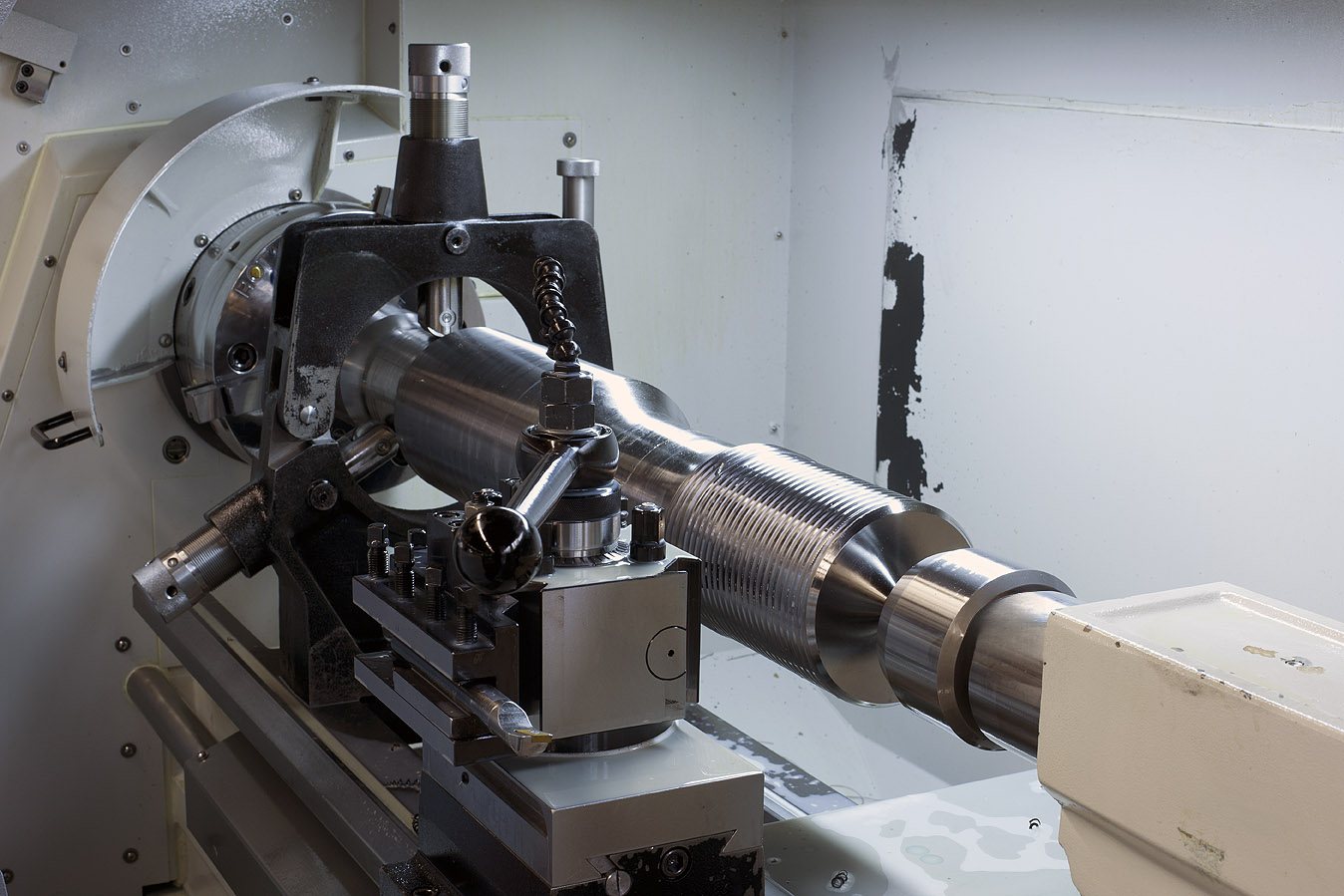
A steady rest is a support on the lathe: rollers or jaws grip the rotating workpiece from three sides and hold it where the tool is cutting. Without it, a long, slender part bends under the cutting force and its own weight, starts to vibrate and ends up thicker in the middle than at the ends; the surface shows chatter marks. With a steady rest, the part stays round, cylindrical and free of vibration over its entire length.
Where long turned parts are needed
Tie rods for presses and vessels, long reduced-shank bolts and studs for turbines, spindles, shafts, piston rods, coupling rods and bolts for cranes, rolling mills and marine engines. These are often one-offs or small lots in quenched and tempered steel, stainless steel or special alloys, with fits, threads at both ends and tight tolerances for runout and straightness.
How RS Randack turns long parts
On CNC turning centres with travelling steady rests controlled by the program; parts longer than the working area pass through the spindle and are supported there. This allows turned parts up to 3,500 mm long and up to 300 mm in diameter; steady rests are typically used up to around 150 mm diameter. Surfaces down to Ra 1.6 are turned directly, finer fits are ground. After quenching and tempering, long parts are checked for straightness and straightened if necessary; the thread is then rolled. On request, runout, straightness and fit dimensions are documented in the dimensional report.
What you should specify
Drawing with length, diameters, tolerances for runout and straightness, surface finish, threads and fits, material and heat treatment condition, quantity, certificate and dimensional report.
Enquire about long turned parts to drawing
Urgent? You will hear from us within a few hours.