
Knowledge base
Quenching and tempering (Q&T) of high-strength fasteners
How Q&T steel achieves its property class and how it is verified
Term explained
How Q&T steel achieves its property class and how it is verified
Quenching and tempering is the heat treatment that gives a Q&T steel its strength and toughness. It consists of two steps: during hardening, the steel is heated to hardening temperature and quenched in oil, water or polymer; it becomes very hard but brittle. During tempering, it is then heated to a temperature between approximately 450 and 650 °C and held there; hardness decreases and toughness increases. The tempering temperature sets the property class: 8.8, 10.9 or 12.9 from the same material. The delivery condition +QT on mill certificates means quenched and tempered.
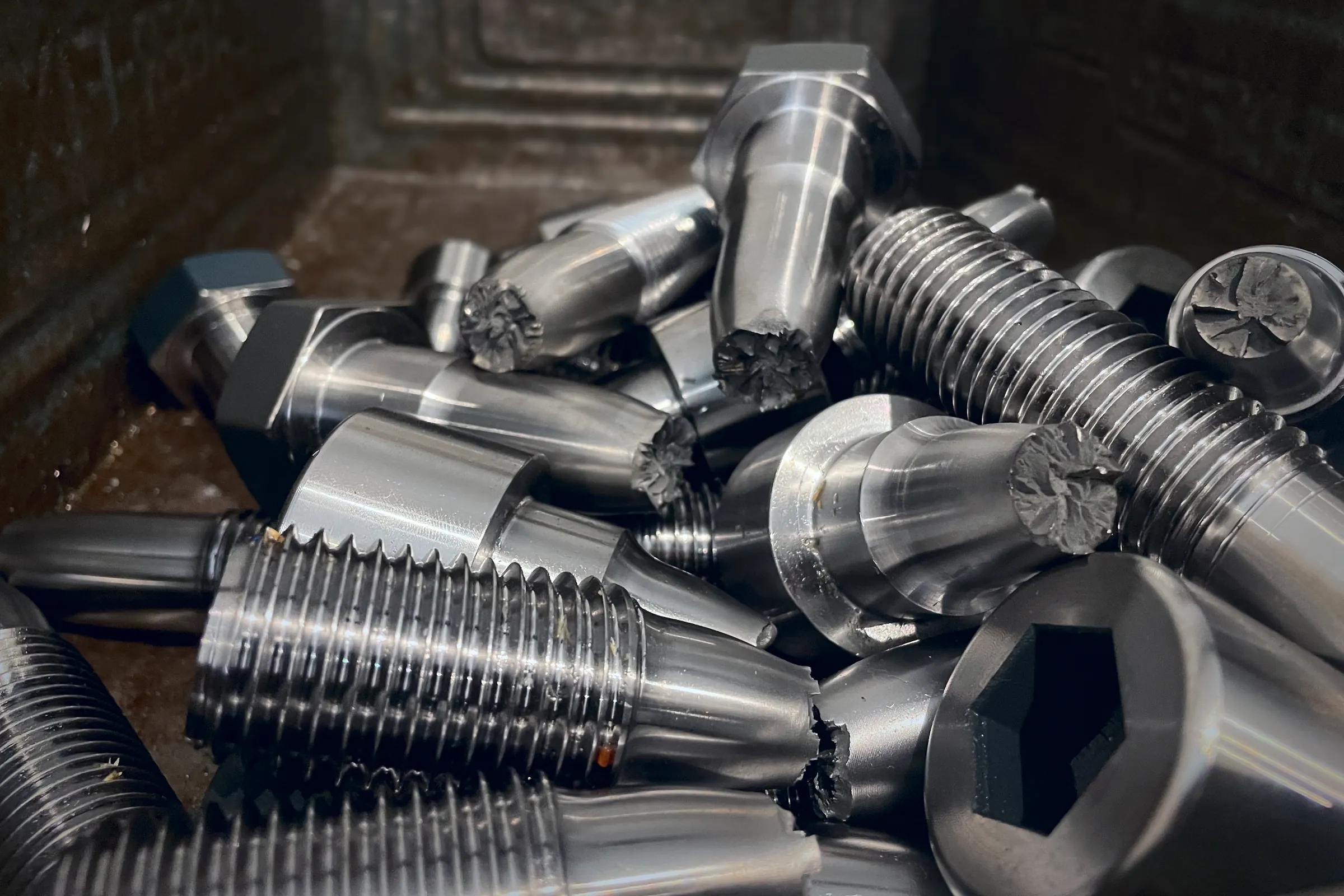
Through-hardening and diameter
During quenching, the core must cool quickly enough. The larger the diameter, the more slowly the core cools and the higher the alloy content must be. 42CrMo4 can be quenched and tempered through to the core up to about 100 mm, 30CrNiMo8 and 34CrNiMo6 considerably further. That is why, for large bolts, the choice of material is tied to the property class, and why strength is verified on a test bar from the same lot or in a full-size tensile test on the whole bolt, not just near the surface.
How RS Randack carries out quenching and tempering
Heat treatment is carried out by qualified partner companies with protective atmosphere furnaces that work to ISO 9001 and are regularly assessed; parts and companion test bars travel there and back together. On return, our own materials laboratory carries out hardness and tensile tests, determines impact energy and, on request, examines microstructure and surface decarburisation. A poor result blocks the entire lot. Quenching and tempering is followed by straightening, finish turning and final rolling of the thread, so that the work-hardened flanks are formed in the already quenched and tempered material.
What you should specify
Property class or minimum values for tensile strength, yield strength, elongation and impact energy, test temperature, hardness range as per drawing, whether the thread is to be rolled after quenching and tempering, certificate type.
Enquire about quenched and tempered special fasteners with certificate
Urgent? You will hear from us within a few hours.